العربية
 Türkçe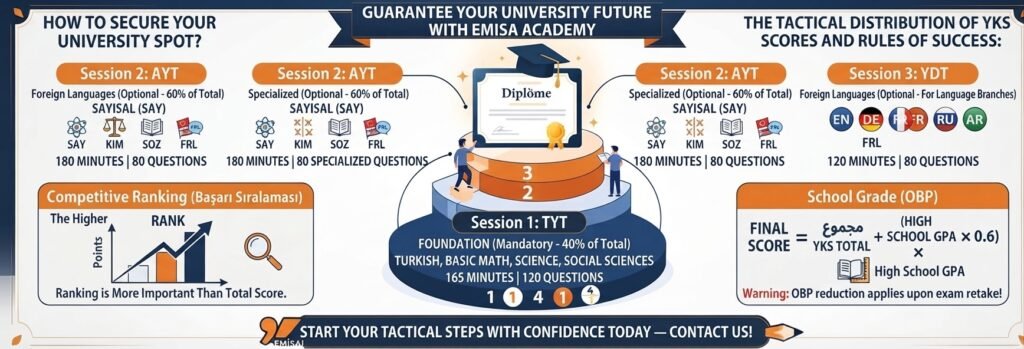
Tactical Distribution of YKS Scores and Success Rules: How to Secure Your University Placement?
When preparing for the Higher Education Institutions Examination (YKS preparation) in Turkey, success is not just about solving the maximum number of questions; it requires understanding the deep philosophy behind how scores are calculated and how placement rankings are determined.
The true tactic for success lies in knowing how scores are distributed, understanding the competitive ranking system (Başarı Sıralaması), calculating the impact of your high school graduation grade (OBP), and reviewing the details of the three exam sessions (TYT, AYT, YDT) along with the minimum score requirements for faculties. In this article, we provide you with the complete tactical guide to direct your efforts in the right direction.
1. General Structure of YKS and Its Three Sessions
The YKS exam serves as the official gateway from secondary education to higher education in Turkey. It is held annually across three essential sessions covering high school curricula:
-
First Session (TYT – Temel Yeterlilik Testi / Basic Proficiency Test): Mandatory for all students, measuring reading comprehension, analysis, and the application of mathematical concepts.
-
Second Session (AYT – Alan Yeterlilik Testi / Field Proficiency Test): For students seeking 4-year undergraduate programs in Numerical (SAY), Equal Weight (EA), or Verbal (SÖZ) fields.
-
Third Session (YDT – Yabancı Dil Testi / Foreign Language Test): For students applying to language programs in 5 approved languages (English, German, French, Russian, and Arabic).
2. TYT Exam Weights and Question Details (The Foundation Rule)
The TYT session forms the foundational pillar of the exam, accounting for 40% of the total weighted score, while AYT contributes 60%.
-
Total Questions: 120 questions.
-
Allocated Time: 165 minutes.
-
Penalty Rule: 4 incorrect answers cancel out 1 correct answer.
-
Minimum Score Condition: Students must achieve at least a 0.5 raw score (Ham Puan) in either Turkish or Basic Mathematics to have their TYT scores calculated.
TYT Question Distribution & Weights:
-
Turkish (Türkçe): 40 questions | 33% weight
-
Basic Mathematics (Temel Matematik): 40 questions | 33% weight
-
Natural Sciences (Fen Bilimleri): 20 questions (7 Physics, 7 Chemistry, 6 Biology) | 17% weight
-
Social Sciences (Sosyal Bilimler): 20 questions (5 History, 5 Geography, 5 Philosophy, 5 Religious Culture) | 17% weight
3. AYT Session and Required Tests by Specialty (Puan Türleri)
In the AYT session, students answer 80 specialized questions tailored to their target field out of a 160-question unified booklet within 180 minutes. A minimum 0.5 raw score in Turkish or Mathematics is required to calculate results.
Required tests according to your specialty track:
-
Numerical (SAYISAL): TYT + AYT Mathematics + AYT Natural Sciences (14 Physics, 13 Chemistry, 13 Biology).
-
Equal Weight (EŞİT AĞIRLIK): TYT + AYT Mathematics (25 Math + 15 Geometry) + Literature & Social Sciences-1 (24 Literature, 10 History-1, 6 Geography-1).
-
Verbal (SÖZEL): TYT + Literature & Social Sciences-1 + Social Sciences-2 (11 History-2, 11 Geography-2, 12 Philosophy, 6 Religious Culture).
-
Foreign Language (YABANCI DİL): TYT + YDT Exam (80 questions in 120 minutes).
4. Competitive Ranking (Başarı Sıralaması) vs. Total Points
One of the biggest mistakes students make is focusing on “total points” rather than “competitive ranking”. Because question difficulty varies from year to year, the competitive ranking (Başarı Sıralaması) remains the truest and most accurate criterion for university admissions compared to all applicants in the same field.
5. Minimum Success Ranking Thresholds (Baraj Sıralaması) for Prestigious Majors
The Council of Higher Education in Turkey (YÖK) enforces strict minimum ranking thresholds required for university preferences and placements:
| Faculty / Major | Minimum Allowed Ranking Threshold (Başarı Sıralaması Barajı) |
| Medicine (Tıp) | Top 50,000 (SAY field) |
| Dentistry (Diş Hekimliği) | Top 80,000 (SAY field) |
| Pharmacy (Eczacılık) | Top 100,000 (SAY field) |
| Law (Hukuk) | Top 125,000 (EA field) |
| Architecture (Mimarlık) | Top 250,000 (SAY field) |
| Engineering (Mühendislikler) | Top 300,000 (SAY field) (Excludes: Agriculture, Forestry, and Aquatic Sciences) |
| Education & Teachers / PDR | Top 300,000 (In the respective field) |
6. How High School Graduation Grades (OBP) Affect Your Final Score
The secondary education success score (OBP) is calculated simply by multiplying your high school graduation average (out of 100) by a coefficient of 0.6, which is then added directly to your final YKS score.
-
Example: If your graduation average is 90 ⟵ 90 × 0.6 = 54 net points added to your final score.
-
Important Warning: If you were placed in a university program during the previous year and choose to retake the exam, the OBP coefficient is halved (0.3 instead of 0.6), which impacts your net added points.
Do you want to map out a guaranteed admission strategy for your university future?
With Emisa Academy, we place our extensive expertise in analyzing YKS results at your fingertips, guiding you toward the major and university best suited for your competitive ranking. We provide comprehensive preparation programs, professional preference consultancy, and continuous follow-up to turn your university dream into a tangible reality.
Take your confident tactical steps today — contact Emisa Academy and ensure your academic success