العربية
 Türkçe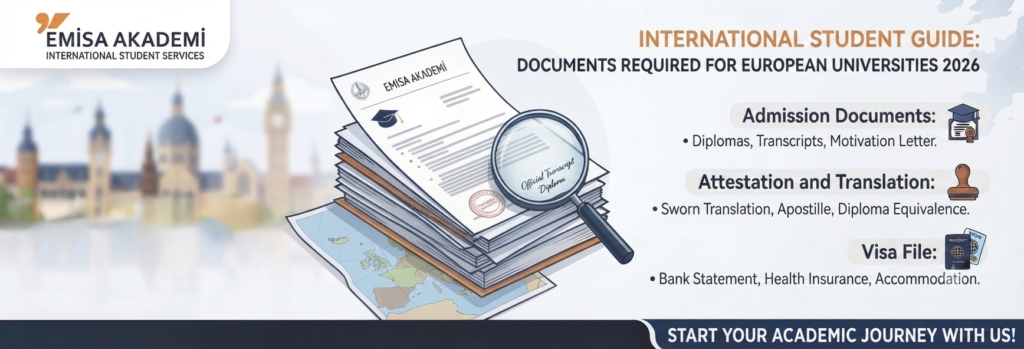
Documents Required for European University Admissions 2026: The Complete Guide for International Students
Proper preparation of your documents is half the journey to acceptance. Missing a single document or failing to provide a sworn translation can delay your file by an entire semester. In this comprehensive guide, we put at your disposal an organized list of everything an international student needs to apply from the university admission stage to securing the student visa.
Disclaimer: Requirements vary slightly depending on the country, university, and major. This is a comprehensive general list, and at Emisa Academy, we verify your specific university’s requirements before getting started.
First: University Admission Documents
For every international student looking to study in Europe, the essential application documents include:
-
High school diploma and transcript of grades.
-
Bachelor’s degree and transcript of grades (for those applying for a Master’s program).
-
Valid passport (bio-data page).
-
Recent official passport-sized photograph.
-
Language proficiency certificate (such as IELTS or TOEFL for English-taught programs, or proof of local language proficiency depending on the country).
-
Motivation Letter — which is considered a powerful and influential element in your university acceptance.
-
Curriculum Vitae (CV) — especially for applicants to postgraduate programs.
-
Recommendation letters — requested by some academic programs, particularly at the Master’s level.
Second: Attestations and Translation for Academic Documents
This stage is frequently neglected and causes the largest delays for European university students, including:
-
Sworn Translation: Translating official documents into the target country’s language or strictly into English through an authorized and sworn translator.
-
Attestation / Apostille: Official certification of certificates and documents; the process varies depending on your home country and study destination.
-
Certificate Recognition / Nostrification: A separate procedure recognized by the state as an equivalent to its local educational system (mandatory in countries like the Czech Republic and Romania).
Third: Documents for Special University Majors
Some academic programs require additional documents during the 2026 European university application process, including:
-
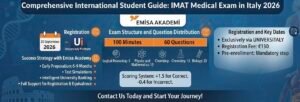
Medical Majors: A transcript clearly highlighting grades in biology and chemistry subjects, and sometimes passing a medical entrance exam (such as the IMAT exam in Italy).
-
Engineering Majors: A special focus on mathematics and physics grades in the academic record.
-
Design and Architecture Majors: The necessity of submitting a professional portfolio.
Fourth: European Student Visa File Documents
After receiving the official university acceptance letter, the process of preparing the student visa application file for international students begins, which requires the following documents in addition to the previous ones:
-
Official admission letter issued by the European university.
-
Proof of financial capability (bank statement / sponsorship letter / scholarship document).
-
Comprehensive travel health insurance .
-
Approved housing proof in the study destination.
-
Police clearance certificate (no criminal record) duly attested.
-
Completed visa application form + visa fee payment receipt.
Golden Tips to Prepare Admission and Scholarship Documents for International Students
-
Start very early: Processes for attestations and sworn translations take weeks, and potentially months.
-
Keep multiple copies: Provide physical and digital copies (scanned) of every official document.
-
Verify document validity: Some universities reject transcripts and documents older than 6 months.
-
Match names literally: Ensure your names match across all documents and certificates with your passport completely without any discrepancies.
Frequently Asked Questions About Applying to European Universities
What is the difference between regular translation and sworn translation?
A sworn translation is performed by an officially certified translator who applies their stamp and signature. It is the only type accepted by European universities and embassies, whereas regular translation is never accepted.
Do I need an Apostille stamp for all European countries?
It depends on your home country and study destination; countries signed to the Hague Convention use the Apostille stamp, while other countries use the standard consular attestation path. We determine the exact correct path based on your personal situation.
Prepare Your File Confidently with Emisa Academy
At Emisa Akademi, we review your documents with precision, determine the university list that perfectly suits you, and handle all sworn translations, attestations, and equivalency procedures ensuring you submit a complete file from the very first time without any delays or risk of rejection.
Contact us today to begin preparing a solid admission file for 2026.