العربية
 Türkçe
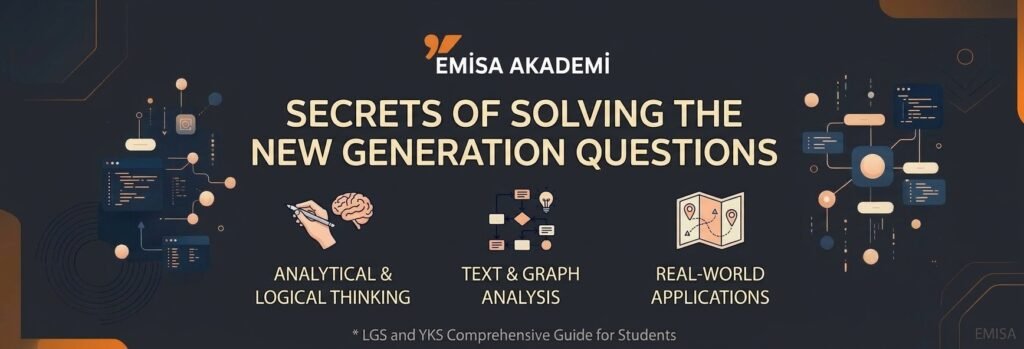
The Secret to Success in Turkey: (Yeni Nesil) in LGS and YKS Exams?
The standardized exam system in Turkey, such as LGS and YKS, has undergone a radical transformation in recent years with the adoption of the New Generation Questions (Yeni Nesil Sorular) style. The exam is no longer limited to memorizing laws, formulas, or direct application of rules; instead, it primarily focuses on logical reasoning skills, reading comprehension, and connecting theoretical concepts to daily life.
Many students feel frustrated when faced with long texts and complex graphs in these questions, but the truth is that these questions have specific “decoding strategies” and handling tactics that make them easier to solve. In this practical guide, we share with you the key secrets and tactics to master new generation questions and achieve top scores.
1. What Are New Generation Questions (Yeni Nesil) and What Is Their Purpose?
New generation questions differ fundamentally from traditional questions (Klasik Sorular), as they are designed to measure a student’s higher-order cognitive abilities according to Bloom’s Taxonomy of Educational Objectives:
- Conceptual Understanding and Analysis: Presenting the student with a problem derived from real-life situations (such as measuring distances, calculating costs, or analyzing a scientific phenomenon).
- Integrating Text and Visuals: Combining tables, charts, and explanatory text to extract given and required data.
- Fast and Deep Reading Skills: The question requires quickly distinguishing between primary information and secondary explanatory details.
2. Top 5 Smart Strategies to Solve New Generation Questions
Strategy 1: Start by Reading the Question Root First (Soru Kökü)
A common mistake is reading the full-page text from the very beginning. Always start by reading the question root highlighted in bold at the bottom so you know exactly what is required, then return to read the text and data with a focused mind knowing precisely what to look for.
Strategy 2: Translate Text into Symbols and Visual Diagrams
Mathematics and science questions in the new generation style contain a lot of word filler. While reading the problem, immediately convert long sentences into simple equations, rough geometric shapes, or data lists in the margin of the exam paper to clear out distractions.
Strategy 3: Elimination Method (Eleme Yöntemi)
Often, reaching the correct answer in philosophy, Turkish language, or science questions is faster and easier by eliminating choices that directly contradict the given data or contain illogical exaggerations.
Strategy 4: Break Down Complex Questions into Smaller Parts
When you see a question spanning an entire page, don’t be intimidated; long questions are usually the easiest to solve because they contain a wealth of explanatory data and context. Divide the question into small steps and solve each stage separately.
Strategy 5: Distinguish Between Essential Data and Misleading Information
Exam committees intentionally include storytelling details at the beginning of the question to add a realistic touch. Train yourself to underline numbers and key terms only, while ignoring side stories.
3. Comparison Between Traditional Questions and New Generation Questions
| Comparison Criteria | Traditional Questions (Klasik) | New Generation Questions (Yeni Nesil) |
|---|---|---|
| Nature of the Question | Direct and relies on applying a mathematical formula or memorizing a rule. | Scenario-based textual problem simulating real life and practical application. |
| Text Volume | Short, consisting of one to three lines. | Long, potentially occupying an entire page with figures and data charts. |
| Required Skill | Calculation speed and strong memory. | Reading comprehension, logical analysis, and data extraction. |
| Study Approach | Solving past papers and repeating formulas. | Reading books, solving critical thinking questions, and chart analysis. |
4. Practical Action Plan to Develop “Yeni Nesil” Question-Solving Skills
- Establish Daily Reading Habits: Dedicate 20–30 minutes daily to reading books and novels to build reading speed and natural comprehension.
- Gradual Progress in Question Banks: Start with direct question bank books to consolidate basic concepts, then gradually move to question banks specifically designed for “Yeni Nesil”.
- Timed Practice (Süre Yönetimi): New generation questions consume more time; practice using timers during homework and mock exams to master time management.
Conclusion
New generation (Yeni Nesil) questions are not an impossible obstacle; they are a learned skill that develops through consistent practice and training. By shifting from reading to analyzing and employing breakdown and elimination tactics, you can turn these questions into a major strength that elevates your competitive rank in YKS and LGS exams.
Master New Generation Question-Solving Skills with Emissa Academy
- Struggling to comprehend or solve new generation questions in LGS and YKS exams? At Emissa Academy, we provide intensive specialized training and detailed explanations of methods to deconstruct and analyze Yeni Nesil questions under the guidance of top education experts.
Contact us today and start your plan toward mastery and academic excellence