العربية
 Türkçe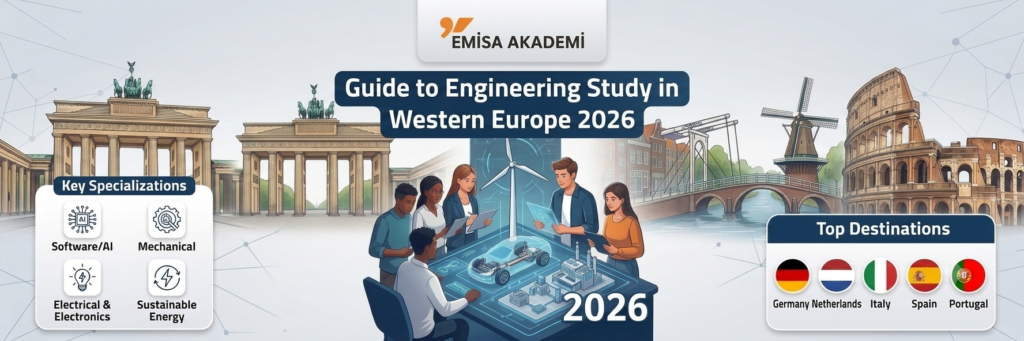
Study Engineering in Western Europe: A Complete 2026 Guide for International Students
Studying engineering in Western Europe is a strategic gateway to accessing some of the most powerful technology and industrial labor markets in the world. Countries like Germany, the Netherlands, Italy, and Spain top the list of the most attractive educational destinations for international students, thanks to their advanced infrastructure and globally recognized academic accreditation. In this comprehensive guide, we review the top destinations, high-demand engineering majors, and tuition fees for the 2026 academic year.
Top Destinations to Study Engineering in Western Europe
If you are looking for academic excellence and intensive practical training, Western Europe is home to some of the world’s best technical universities:
-
Germany: The ultimate destination for studying engineering globally. It features tuition-free (or near-free) public higher education and massive post-graduation career opportunities in the heart of the European industry.
-
Netherlands: Renowned for leading technical universities that offer a wide array of innovation-driven engineering programs taught entirely in English.
-
Italy and Spain: Ideal choices that combine historic, prestigious engineering universities with affordable tuition fees tailored to fit various budgets.
-
France: Celebrated for its elite engineering schools (Grandes Écoles) that graduate leaders in global technology sectors.
High-Demand Engineering Majors for International Students
European universities continuously evolve to keep pace with the global tech revolution. The most sought-after majors preferred by international students include:
-
Software Engineering & Artificial Intelligence: Meeting the booming global demand for cloud computing, AI solutions, and digital transformation.
-
Mechanical & Automotive Engineering: The absolute driving force of Germany’s economy and technical education system.
-
Electrical & Electronics Engineering: The core foundation supporting smart industries, robotics, and modern telecommunications.
-
Energy & Sustainability Engineering: A future-oriented discipline focused on renewable energy systems and environmental protection.
Tuition Fees for Engineering in Western Europe (2026)
Tuition fees in Europe vary significantly based on the host country and the language of instruction. The following table highlights the approximate annual tuition fees for engineering programs:
| Country | Annual Tuition Fees (Engineering) | Important Notes for International Students |
| Germany | Almost Free (Tuition-Free) | A vast number of Master’s programs are available in English. |
| Netherlands | €8,000 to €15,000 | Offers wide-ranging and diverse program options taught in English. |
| Italy | €1,000 to €4,000 | Fees are often calculated based on annual family income evaluations. |
| Spain | €1,500 to €6,000 | Witnessing steady growth in the number of engineering tracks taught in English. |
Why Do International Students Prefer Germany for Engineering?
Germany successfully delivers a golden equation sought out by international talent: tuition-free world-class education paired with Europe’s strongest industrial engineering ecosystem. Furthermore, the country grants international graduates direct paths to integrate into the local labor market and achieve long-term residency via the EU Blue Card. While most Bachelor’s degrees require German language proficiency, English-taught Master’s degrees in engineering are widely available and highly accessible.
General Admission Requirements to Study Engineering in Europe
European universities require a comprehensive academic profile. The primary entry requirements typically include:
-
A strong high school GPA, with excellent marks particularly in scientific subjects like Mathematics and Physics.
-
Proof of language proficiency (either English or German, depending on the language of instruction chosen for the program).
-
Completion of a preparatory year (Studienkolleg) for certain international students looking to study in Germany to bridge the gap and equalize their high school certificates.
Frequently Asked Questions (FAQ)
Do I need to learn German to study engineering in Germany?
For Bachelor’s degrees, the vast majority of public universities mandate proficiency in the German language. However, for Master’s degrees, there is an extensive selection of engineering programs taught fully in English that require zero prior knowledge of German for admission.
Start Your Academic Journey with Emisa Academy
Choosing the right university and major to study engineering in Western Europe is the strategic decision that shapes your international professional future.
At Emisa Akademi, we are here to support you through every single step:
-
We precisely evaluate your academic background and recommend the best-fitting options aligned with your budget and goals.
-
We verify the latest, updated fees and admission requirements for 2026 directly from official university sources.
-
We prepare your entire application paperwork, review documentation, and oversee your student visa file to ensure the highest possible acceptance rate.